Wilmington / Outer Banks, NC.
North Carolina's coastline draws a different kind of buyer. People who want the water as part of their daily life, not just a vacation destination.
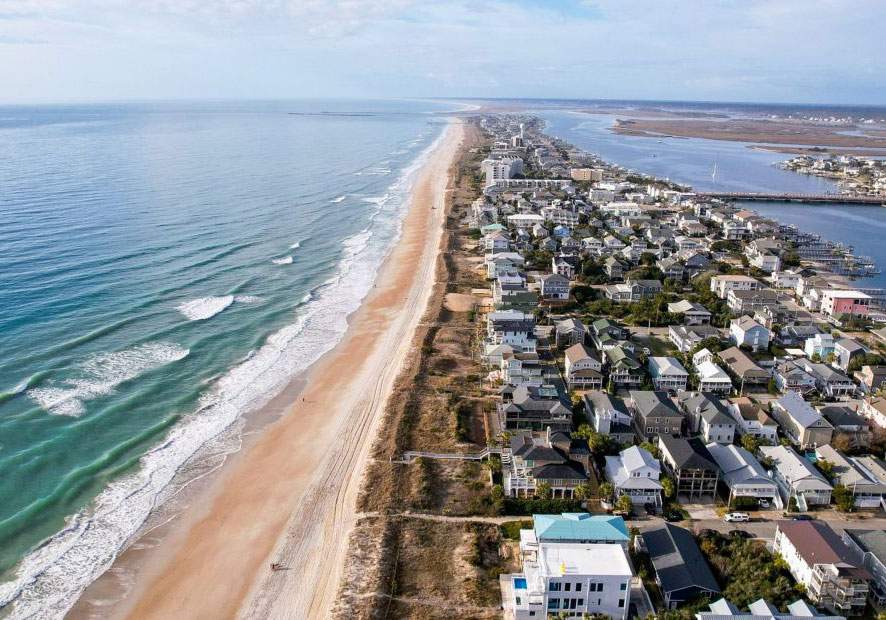 Wilmington / Outer Banks
North Carolina's coastline draws a different kind of buyer. People who want the water as part of their daily life, not just a vacation destination.
Wilmington / Outer Banks
North Carolina's coastline draws a different kind of buyer — people making a deliberate lifestyle choice rather than a commute calculation.
Coastal NC isn't my home market — I'm based in the Piedmont Triad — but I'm a licensed North Carolina agent and I work across the state. What's below is an honest overview of both markets: Wilmington as the primary coastal city, and the Outer Banks as the barrier-island alternative. Two very different buying experiences, both worth understanding clearly before you make a decision.
A real city with real urban infrastructure — beaches, riverwalk, film industry, and a UNC campus — without the year-round isolation of barrier-island living.
Wilmington is a real city of about 130,000 in the city proper, 300,000+ in the metro. It sits on the Cape Fear River about 10 miles from the Atlantic — coastal identity without the year-round isolation that barrier-island living can bring. Downtown is genuinely accessible — restaurants, bars, boutiques, and historic architecture along the Riverwalk. The film industry has a significant footprint here (Screen Gems Studios, EUE/Screen Gems), shaping both the local economy and the creative character of the city. Wrightsville, Carolina, and Kure Beach are a short drive from most of the metro.
UNC Wilmington anchors education and supplies the rental market with consistent demand. Healthcare has grown significantly as the city's population has expanded. The broader economic base is more varied than a pure tourism economy — which gives Wilmington a resilience the Outer Banks doesn't have in the same way.
Median prices have been running $430,000–$482,000 depending on data source and timing, with steady appreciation year over year. Cost of living about 5% below the national average — unusual for a coastal market — making Wilmington one of the more accessible coastal cities in the country relative to what it offers. Range is significant by neighborhood: Wrightsville Beach and Landfall average above $1M; Ogden and Porters Neck closer to $360,000–$525,000; Castle Hayne and Northside in the $275,000–$325,000 range.
The honest trade-off: the market is moving toward balance after several years of strong seller conditions. Days on market: roughly 60–79. Buyers have more room to negotiate than they have had in a while, particularly at the upper end.
Wrightsville Beach — most desirable, most expensive; oceanfront village feel. Landfall — gated, golf, the most established upscale suburban option. Porters Neck — golf-course living north of the city with newer construction. Ogden — close to Wrightsville and more accessible. Historic Downtown — Riverwalk, restaurants, converted historic homes. Carolina Beach & Kure Beach — beach proximity without paying Wrightsville prices.
Not a suburban market with a beach nearby — 200 miles of barrier islands where the lifestyle is the product. A cluster of micro-markets, not one market.
The Outer Banks is 200 miles of barrier islands stretching from Corolla in the north to Ocracoke in the south. The lifestyle is the product. You're buying into a specific way of living that doesn't translate to every buyer. Year-round population is small. Infrastructure is limited — one road in and out of most communities, grocery options that require planning, and the understanding that a storm can change things.
The market is hyperlocal in a way most real estate markets aren't. What's true of Duck is not necessarily true of Nags Head. Each town has its own feel, price point, and character. Buyer profiles split into three groups: primary residents who chose the OBX lifestyle deliberately, second-home buyers who want a beach house for personal use, and investors buying for short-term rental income. Each approaches the market differently.
Average sold prices have been running $790,000–$870,000 in recent data — though that figure is pulled significantly upward by oceanfront and luxury. More accessible entry points exist in Kill Devil Hills and Kitty Hawk where the mid-market is more active. Duck and Corolla skew higher. Hatteras Island offers the most affordable access to the OBX lifestyle.
The honest trade-off: the market shifted notably in 2025 toward buyers. Inventory rose, days on market increased, price reductions became more common as sellers adjusted. The frenzied pace of 2020–2023 is over. The 2026 OBX is a market where buyers have more time, more options, and more negotiating leverage than at any point in recent years.
Short-term rental note: investment appeal has historically been tied to rental income. Properties in prime locations with good rental histories can generate meaningful income, but STR regulations vary by town, insurance costs on barrier-island properties are significant, flood insurance can run thousands annually, and rental projections from sellers should be verified carefully — not taken at face value.
Duck — upscale village feel, boutique shopping, sound-to-sea properties, strong appreciation; not the entry point. Kill Devil Hills — central OBX, more accessible price points, year-round community. Corolla — northern OBX including the famous 4x4-only area with wild horses. Nags Head — historic, mix of cottages and newer construction; corrected ~14% in mid-2025. Hatteras Island — southernmost and most remote part accessible by road; the most affordable entry point and the strongest sense of year-round community identity.
Most coastal NC properties — Wilmington or OBX — require flood insurance. Not optional, not cheap. Factor it into your monthly budget before you fall in love with a listing.
Coastal NC is in a hurricane zone. This affects insurance costs, the type of construction that holds up, and the resilience of your investment. Properties built above certain elevations and to modern construction standards fare better. Ask about this before you make an offer.
The OBX especially is a collection of micro-markets that behave differently from each other and from the broader NC market. Working with someone who knows the hyperlocal dynamics of a specific town isn't optional — it's essential.
Like the rest of NC, coastal NC closes through licensed attorneys, not title companies. The NC due diligence fee system also applies — a non-refundable fee paid directly to the seller, separate from earnest money held in escrow.
Coastal living is a lifestyle decision — if water is the point, the Triad isn't a substitute. But: median home prices in Winston-Salem and Greensboro run $150,000–$200,000 below the Wilmington median and well below OBX averages. Flood insurance, wind insurance, and coastal maintenance costs don't apply in the Piedmont. The Triad is a 3–4 hour drive from Wilmington and OBX — beach access becomes a weekend trip rather than a daily backdrop. Worth knowing before the coastal premium locks you in.
If you're weighing Wilmington / Outer Banks against other options, I'm happy to walk you through the differences — on the phone, over coffee, or in person.